Chris James, East Anglia Timber Trade Association (EATTA) chairman, knew what he was looking for when he started planning the second ‘Who Teaches the Teacher?’ trip. With a willing collaborator in Tabitha, TTF’s new Regional and University Engagement Manager, who engages teachers thirsty for first-hand knowledge – he had to find the right business to host the group of lecturers, with a willingness to share their forestry, mill and production practices. Ian Drane of VIDA Wood UK Ltd stepped forward keen to show how Vida AB operate in Sweden – and they could also throw in a visit to their house building factory too, if that might be of interest!
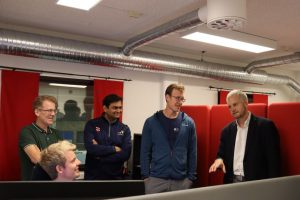
So in early September, dodging annual holidays, term time, airstrikes and job changes – Chris, Ian and Tabitha departed for Sweden with four lecturers from the EATTA region: Aftab Jalia, Architecture – Cambridge University; Rob Foster, Engineering – Cambridge University; Richard Longstaff, Architectural Technology – Anglia Ruskin; Terry Connolly, Carpentry – Bedford College.
The packed two day itinerary included: A tree nursery – could these 75mm high Norway spruce (Picea abies) seedlings really produce trees of 45m in height with a butt diameter of up to 1m in 80 years – with just sunlight and water?; Forestry and modern harvesting – a chance to sit in a harvester cab and see first-hand how man and machine work together to fell trees to order, cutting to species, dimension and length; Vislanda Mill – producing 300,000m3 of long length red and whitewood pa with a timber yield of up to 70% from each log thanks to computer 3D scanning; Alvesta Mill – producing 180,000m3 of short length red and whitewood pa; Vida Building – producing flat pack and modular buildings up to Passivhaus standards – the fully finished panels for Rainham Passive Close, Essex came from here; Vida’s new head offices – CLT structure, clad with OrganoWood and roofed with ThermoWood. Accompanied throughout by Kristina Kuhner (Office manager customer service) and Anders Svensson (Quality Control Manager of Vida), who have both risen through the ranks in their 25 plus years with the company, we had a real sense of a caring and convivial company that appreciated its workforce, no mean feat considering its size!
The lecturers came from architectural, architectural technology, carpentry and engineering disciplines “The aim is for each lecturer to enliven students’ and colleagues’ interest in the timber business and in timber as a sustainable building material,” says EATTA Chairman Chris James of Nason Davis.
“Through such visits we can get our industry’s message across directly to the specifiers and architects of the future. These four lecturers alone enable us to reach over 600 students, broadening their knowledge and increasing enthusiasm for wood amongst those teaching engineering and architecture plus updating our future carpenters’ knowledge. Over five years we could potentially see 1500 new specifiers favouring timber and wood products as a result of this initiative,”
Chris James
Ian Drane said “The Vida Group were delighted to host this most successful and enjoyable visit. The four university lecturers returned to the UK with a greater appreciation of the Swedish sawmilling industry and it’s sustainability, keen to share this knowledge with their students.”
Tabitha Binding commented “We are indebted to Chris, EATTA, Ian and Vida who have helped further the knowledge of our future professionals across multiple disciplines through ‘Who Teach the Teachers?’ This hands-on approach pays dividends – watching this years’ cohort of lecturers begin to fully understand the care, passion and collaboration that it takes to plant a seed, grow a tree and manage it for 80 years before harvesting, milling, grading and drying a fully sustainable construction material, reinforces my belief that you cannot comprehend the scale, sophistication and relevance of forestry and timber production to our current and future construction requirements by just reading about it – you need to see it. Students will directly benefit from the knowledge that these lecturers have gained.”


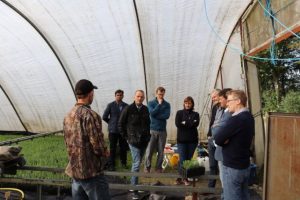


“The Nursery was a completely new area for me, a revelation in in how trees start out in a commercial setting and the sheer scale of the production – one poly tunnel 300,000 new trees! Prior to visiting the forest in Alvesta I was aware of how trees are harvested in a commercial setting but actually seeing the machine in action truly reinforces the speed, accuracy, efficiency and sustainability… having been given the opportunity to sit in the cab, see first-hand the level of information these machines can process – location (GPS), length and volume of timber being processed for orders direct from the mill.” Terry Conolly
“Nothing is wasted. Vida’s sawmills produce not only standard timber products, almost 75% of which are exported, but also a host of ancillary co-products that contribute financially: finer wood shavings find a new life as beddings for rabbits, pigs, etc; courser shavings and sawdust go to wood pellets and biomass –some of which is used to run the kilns.” Aftab Jalia
“This trip reinforced my sense that appropriately managed forestry and timber production present us with a construction material that can be used to help design a more sustainable built environment. The biggest impact that this trip will have on my teaching is a renewed sense of the importance of helping my engineering and architecture students to understand the full context in which they will make material selection decisions – rather than solely considering aesthetic or structural considerations. The experience will also enable me to be more authentic in my communication of the realities of the forestry and production processes. As a researcher the trip also provided useful insight into the scale of the opportunities for further improvement in our use of structural timber in the built environment and some of the potential challenges.”Rob Foster
“The mills are largely automated and computer-controlled, processing a 4m log every 2.5 seconds – the computers scan the logs to give a 3D image, working-out the optimum cut ratio for that log determined by the market value and current demand, all in a split second! Machinery then manoeuvres the log to optimal position before cutting the log into sectional timbers using a 2.5mm industrial bandsaw – this saves 100’s of M3 usable timber each year compared to a circular saw with a width of 5mm.” Richard Longstaff
The VIDA group employ 1,100 people, have 18 production plants, turnover 6.4 billion SEK, produce 1,750,000 m3 of sawn timber (74% of business turnover) of which 75% is exported worldwide of this 31% comes to the UK market – a not inconsiderable 407,000m3! They also produce packaging (11% of turnover), energy from residues (13%) and housing (2%). Vida buy their logs from forest owners in the south of Sweden and pride themselves on customer-tailored solutions. In February 2019 Canfor acquired a 70% stake in Vida AB.